Category: Dailies
Hitting the road
Another really tough loss today. Matt Cain had a no-hitter going into the fifth and we ended up losing, 13-8. Five losses in a row at home, and now we’re off to Colorado, Florida and Arizona for nine games on the road.
We’re very, very frustrated with what we’ve done so far as a team, I can tell you that. There were times during this homestand that I could hardly move from my locker after a game. I always try to talk to reporters because when I talk to them, I know I’m talking to the fans. But sometimes I take the losses so hard, I can’t talk to anybody.
I know other guys feel the same way. You always feel, if you didn’t come through when you’re needed to, that you let all your teammates down. And you let the fans down. That’s the worst feeling.
Still, you know you have to put it behind you. You have to keep fighting. That’s the only way. You don’t make it very far in baseball if you can’t battle through tough times. There is so much failure in this game that it’s easy to get beaten down by it. The ones who DON’T let it crush them are the ones who survive at the Major League level. And believe me when I tell you that this is a team not just of survivors, but of warriors. When we get to the ballpark in Colorado, we’ll put a fence around this awful loss and be ready to go 150 percent.
Part of what I do to get ready at the start of each series is to study the inch-and-a-half-thick scouting report on our opponent. Right now, I’m on the plane from San Francisco to Denver and going through the reports on each batter for the Rockies: How have they been swinging lately? What percentage of the time do they swing at curve balls, sliders, fastballs? What do they want when they get one strike? Two strikes? How do they run?
Steve Holm is sitting in the row in front of me, and he’s going through the same stack of papers. We talk about the hitters and get an idea on how to pitch to each one, how to get each one out. At the ballpark, we’ll watch videos of the Rockies’ last few games with Dave Righetti and Mark Gardner, the pitching coach and bullpen coach. Those two guys are very, very prepared for every team. It’s amazing how much homework they do. So we go over the lineup together and come up with a plan for every batter.
Of course, once the game starts, what we prepared for and what actually happens could be totally different things. A batter might not do anything that the scouting report said he would. So Holmy and I have to be ready to adjust. Between innings, we’ll consult with each other and with Righetti about the next three guys in the order. Sometimes, in the dugout, I’ll look at the scouting report again to refresh my memory about a particular guy. Then, after all the hours of preparation, it’s up to the pitcher to make the pitch.
Two real positives of this homestand were Omar Vizquel’s return from the disabled list and Tim Lincecum’s continued great pitching. Omar is always so motivated and happy that he lifts everyone up. We feel pretty secure when he’s out on the field. Not taking anything away from the younger guys, but Omar is a veteran, a future Hall of Famer, and when he’s out there, we all feel pretty good.
People have been asking me what makes Lincecum special. The first thing I say is he has a great heart. He’s not afraid of anything. He’s not afraid of getting hit. His skills, of course, are amazing: He throws over 95 mph, has a great changeup, a great slider and curve. But what makes him so good, at least in great part, is that he believes no one can hit him. Sometimes pitchers give too much respect to batters. But Lincecum always seems to believe that no matter how great the batter’s reputation, he’s better, and he’s going to get him out.
OK, I should get back to studying this scouting report. Thanks for checking in. I’ll try to write more often. But I admit, when we lose, I’m not very eager to share my thoughts.
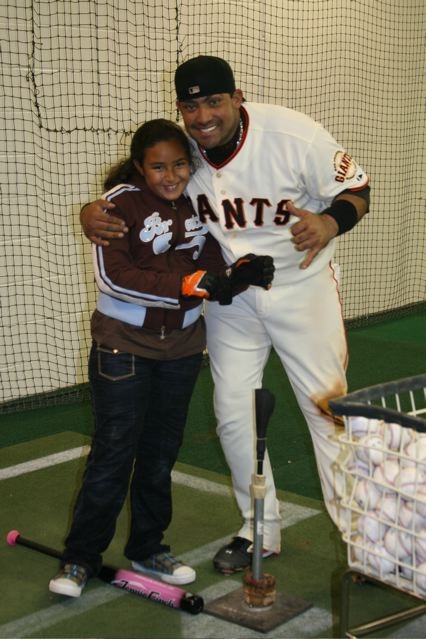
And during homestands, I’m trying to spend as much time with my family as I can, so I run out of time for anything but family and baseball. I took my younger daughter to the Exploratorium on Saturday and had a great time. What an amazing place. She thought it was awesome. Then after the game Saturday night, I took her into the batting cage behind the dugout and tossed balls to her. I was still in my uniform and dog-tired. But she was so happy that we stayed until about 11. She flew back today to Yuma, where she lives with her mother.
The toughest part of any homestand, besides letting go of the losses, is saying good-bye.
Be patient with young players — and me
I imagine there were more than a few people cursing at their TVs back in the Bay Area at the end of game Sunday against the Phillies. Velez let a grounder slip under his glove and the Phillies scored the winning run. It’s frustrating to watch from the dugout, too, but we know we have a team of very young guys who are going to make mistakes. And we know they want to win as much as any of us.
These are really, really good players and we have to have patience with them. Don’t get me wrong. It’s tough, for sure. It’s really, really hard to see a game slip away like that. But these guys are going to be great players for the Giants. They have a lot of heart and a lot of enthusiasm. They’re young and still learning how to play in the big leagues. I tell them when they make a mistake there’s no time to get down on themselves because there’s another game tomorrow. There’s not time for feeling bad. Learn from the mistake, turn the page and move on.
I promised to answer your questions in this post, so here goes.
Zman asked what my teammates and I do with our fan mail. I try to sign all the cards I get right away and send them back. I used to put them aside and promise myself to get to them later but then they piled up. So I now open the envelopes and sign — I mostly receive baseball cards. Sorry you didn’t get yours back, Zman. Try me again.
Hgravity, I’ll do my best to remember to tell Steve Holm that Steve Corey Watts said hi.
Aubrey wanted to know if it’s weird playing against my brothers. The answer is yes, it’s weird in every sense of the word. It’s weird and tough, really, really tough. On the one hand, you want him to do great, but at the same time, I play for San Francisco. I say to Yadier, “You try to get me out because I’ll be trying to get you out.” We kept it professional on the field then after the game, we’re brothers again. We’ll ask each other, now why didn’t you guys try to move the runner over? Strategy things.
I know someone asked about my equipment (but now I can’t find the question — sorry to whoever wrote it). I choose whatever equipment I like. Major League Baseball and the Giants don’t have rules on which company you can and can’t use. Right now I use Reebok equipment. The most important thing for me is making sure my legs are comfortable, my knees especially.
I was happy to have a day off Monday to refresh my legs. Looking forward to the Pittsburgh series — then back home. We love playing at AT&T in front of our own fans. The fans give us that little extra energy to pull us through — and we need it with all the tight games we’ve been in lately.
Thanks for writing — and reading. I’ll check in again soon.
On Z, and a mysterious balk
We’re in Philadelphia,
about to start a three-game series against the first-place Phillies.
Obviously a lot happened during the final days of our homestand,
the biggest news being Barry Zito’s reassignment to the bullpen. Tonight would
be his usual turn in the rotation and instead Pat Misch will take the mound for
his first start of the season.
It’s hard to know what to think about Z going to the
bullpen. We’ve just got to go with it and understand that moves are made to put
us in a better position to win. We have no control over the decision. We have
to just try to understand it as much as we can.
What we can do is make sure Z knows we’re right behind him
100 percent no matter what happens. Right now his mind is probably going crazy
with this situation. So we pretty much have given him his space and haven’t
said much to him. But later, when things settle down a bit, every time I talk
to him I’ll let him know we’re behind him, that this is a team effort and we’ll
all get through this together.
I remember going through a really tough time in 2001 when I
was so low I wondered if I could even play anymore. I had a right hamstring
injury that put me on the DL for two months. I wanted to prove that I could
play the entire season every single year – and then running to third base one
day in May of 2001 I heard a pop and I could barely take another step. It was
such a setback because I was in just my second full season in the Big Leagues.
I let myself get really down for a while. Then I realized
that the best way to deal with failure and adversity is to face it. Face what
you’re doing and tell yourself you’re struggling now but it’s not forever. You
have to face each day with a positive mind.
Rafael Palmeiro gave me the best advice about how to deal
with slumps and setbacks. Maybe you’re not swinging well. You don’t know what’s
going on. He told me, “Hey, it doesn’t matter how bad you feel, how horrible
you’re going. Every time you step to the plate, you tell yourself you’re the
best guy out there. You’re the man. That guy can’t get you out.”
I figured, if that’s the approach of Hall of Fame caliber
guys, then that’s what I’d do too. Every day after that – which was early in my
career, 2001, 2002 maybe – every single day, I take a positive mind onto the
field. I tell myself, “You’re better than that guy on the mound. He can’t touch
you.” You give credit to him when he gets you out, but until then you don’t
give him anything.
I think the same approach applies in lots of aspects of
life. If you have a problem and you’re not feeling good, you don’t go into work
or school all mad and make everybody else miserable. If you let your mind tell
you that you’re horrible, you’re going to be horrible. If you let your mind
tell you you’re going to fail, you’re going to fail. Ninety-five percent of
life is about your mind. It dictates what you’re going to do and what you’re
going to be.
I learned this lesson on the baseball field, but I use it in
raising my two girls. I use it in my personal relationships and my business
dealings. If you go out there expecting to succeed – expecting not only to
succeed but to be the best – you give yourself a really good shot at succeeding
and maybe even being best.
Sounds pretty simple, but of course it isn’t. If it were
that simple, Z would be on the mound tonight starting against the Phillies. He
has so much heart and so much desire that I know he’ll get through this. It
will take all of us – the coaches, the staff, his teammates. He’s going to be
great again. I don’t have any doubt.
The other news from the home stand was the balk call against
Tim Lincecum.
Here’s what happened. . There was a runner on third, and we
had a play called for Tim to throw over there at that moment. I saw Timmy was
in a windup instead of the stretch. He can’t throw to third from the windup. I
immediately called time-out. But obviously Tim was already started, and he
stopped as soon as I called time. The ump also called time then he suddenly
called a balk.
I told the ump he called timeout, too, and he said he never
called it. Of course, the TV replays show clearly he DID call it, and that’s
why Timmy stopped. He didn’t stop because he was trying to deceive the runner –
which is the whole reason behind having the balk rule. So it definitely should
not have been a balk.
It was a horrible way to lose a game. We were all really
angry about it. It’s just not a way to lose a game. If we lose by getting our
butts kicked, OK. But you never want to lose like that.
But it’s over now and we have to just think about the
Phillies tonight.
In my next blog, I’ll answer the questions you have asked.
Thanks again for reading and writing and being such great, supportive fans.
Where does the time go?
Sorry for the delay in writing a new post. You always think you’ll have time for things other than baseball during the season, but your whole life is on the field and in the clubhouse. I have loved reading all your comments … Arriving new last year to this team, I didn’t know what to expect from the fans. Now there’s no doubt that you are behind me and behind this team. And that’s what it’s all about.
But back to trying to figure out where all the time goes during a baseball day.
I get to the ballpark three or four hours before the first pitch, as most of the guys do. I change out of my street clothes. Go to the trainer’s room for treatment. Take care of business like opening mail, ordering bats or other equipment from Murph, our great clubhouse manager. I talk to reporters if any of them need me for anything. I meet with Dave Righetti, the pitching coach, and Mark Gardner, the bullpen coach, and the pitchers to go over the hitters we’ll be facing. Then I take the field for batting practice.
Then for an hour or so before the game, I like to put on my headphones and listen to my iPod, getting myself focused and ready.
I needed all the focus I could get for that 13-inning game against the Padres last week. People asked me later how my knees and legs felt from squatting for so long, but during the game I don’t feel any soreness or pain. I’m so focused. I’m running on adrenaline. But I felt it later, needless to say, despite my usual 10-minute soak in a cold tub to rejuvenate the muscles.
Let me tell you, it’s no fun sinking into a cold tub after a chilly night game. But it’s the best thing for a battered body, so you do it.
One of the things I loved about that game, other than the fact we won — and that I managed to hit a home run to tie the game, 1-1, in the ninth — was watching Bochy move the chess pieces. A game like that is where the beauty of a manager comes in.
That kind of game is the true test of a manager. He has to make all those moves to keep his team in the game as each inning goes by. He has to make sure everything’s OK, that we’re not caught short on the bench, that we have the right guys in the right places at the right times. He did an unbelievable job.
After a game like that, I can’t sleep. I can’t sleep after a lot of games, actually, even the ones we win. My eyes are open and I’m replaying almost every single pitch in my head. I second-guess myself. Maybe that guy wouldn’t have gotten a hit if I had called something else. Most of the time your mind is going crazy. You know things are going to happen in a game that you have no control over, and you tell yourself that, but I have a tough time letting go. It’s something I should probably work on. Or maybe that intensity off the field is what keeps me so focused on the field.
Boch gave me the day off after the 13-inning game to rest my legs, so I got to watch Steve Holm behind the plate. Steve is 28 years old and in the Major Leagues for the first time. He had never played higher than Double-A and suddenly he found himself making the team out of Spring Training, surprising everyone. Steve is such a great, great guy. I love Steve. He listens. He’s always asking questions. We’re always talking in the dugout about the game, whether he’s catching or I am. Neither of us ever feels like we’re out there by ourselves.
We talked about his play at the plate in the wild 10-9 game Saturday against the Reds. In the seventh inning, Joey Votto slid in around Steve’s glove even though it looked like the throw got there in time. To people who don’t know catching, it might have seemed that Steve “missed” the tag. But Steve did exactly the right thing.
The throw came to the right side of the plate. So Steve had to be looking to the right side — while the runner was barreling toward the plate on his left. The catcher can’t see the runner. We don’t have eyes in the backs of our heads. So what he has to do, as soon as he catches the ball, is wheel around and slap the glove on the ground where the runner is going to slide.
In Steve’s case, he actually swung around so quickly, he got his glove down a split-second before Votto arrived, and so Votto was about to slide around the glove.
A similar thing happened to me in Arizona. Brandon Webb stepped over my glove as I swung around to tag him.
(I hope Steve spent more time after the Reds game thinking about the huge double he hit to keep us battling back rather than the play at the plate.)
I took a second day off on Sunday to refresh my legs, but I’m back in the lineup tonight against Colorado. I miss being on the field when I take a day off. But as I said in my first posting, this is a marathon, not a sprint, and we have to take care of our bodies so they’re as ready to do battle on the last day of the season as on the first.
I remember as a young player, new to the league, I wanted to make my body the strongest it could be. I had seen all the “Rocky” movies and decided to train like him. When I returned to Puerto Rico in the offseason, I worked out by cutting down trees, pulling tractor tires, running in the sand, running the hills. The local people started calling me “caballo loco” 0- crazy horse. I don’t train that way any more, but I know my body has to be in top shape to last through a 162-game season — especially if we have more of those 13-inning nights.
Keep writing! I appreciate every minute you spend reading this and every kind word you send my way.
I’ll try to check back before we go back on the road Thursday.
Managing pitchers and giving it everything
In my last blog, I mentioned the psychology of managing pitchers and how this is part of what I love about catching.
People often ask me what I say to pitchers when they see me go to the mound in the middle of a game. First, I should say that I try not to go to the mound too often. I don’t want the pitchers to be thinking I’m there bothering them. I want them to keep their concentration. But I also want to help get them out of trouble when it’s necessary.
And that’s the beauty of catching – reading the situation, knowing the personality of the pitcher, figuring out when it’s too early to say something and when to step in before it’s too late.
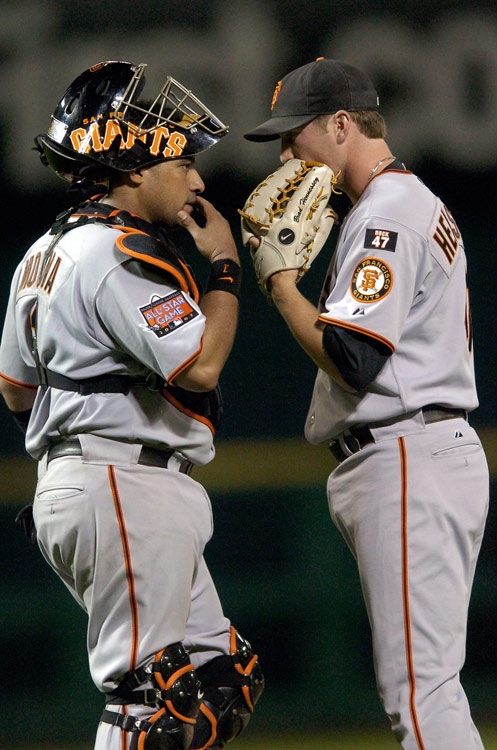 When Barry Zito was on the mound during the last game of the homestand and he was walking some guys, I went out there. I didn’t say anything about how he was pitching. He knows what he’s doing. What I told him was that we’re all here behind you. We’re all in a Giants uniform and we’re all in this together. That’s not going to change no matter what the outcome of the game is. We got your back. OK, let’s go.
Sometimes, of course, I remind a pitcher of something the pitching coach told him in the bullpen before the game. Sometimes I’ll just tell a pitcher to stay back, take his time, get into his rhythm.
The beauty of catching is you have to know all the personalities of the pitchers. It’s not always WHAT you say but HOW you say it. Not everything works for everybody.
I’ve been asked how long it takes for me to get to know what works and what doesn’t work for a pitcher. I’d say about five outings. And that goes both ways — that’s about how long it takes the pitcher to learn to trust me as his catcher.
What I really like about this Giants team is how much trust there is in each other. Everybody is looking out for everybody else. The TV cameras, I know, caught me in the dugout recently giving some instruction to Brian Bocock, our young shortstop. I was telling him that he had to be patient in the batter’s box. He was in a new league, facing new pitchers. He needed to wait on the breaking ball and go the other way to right field and not try to pull everything to left.
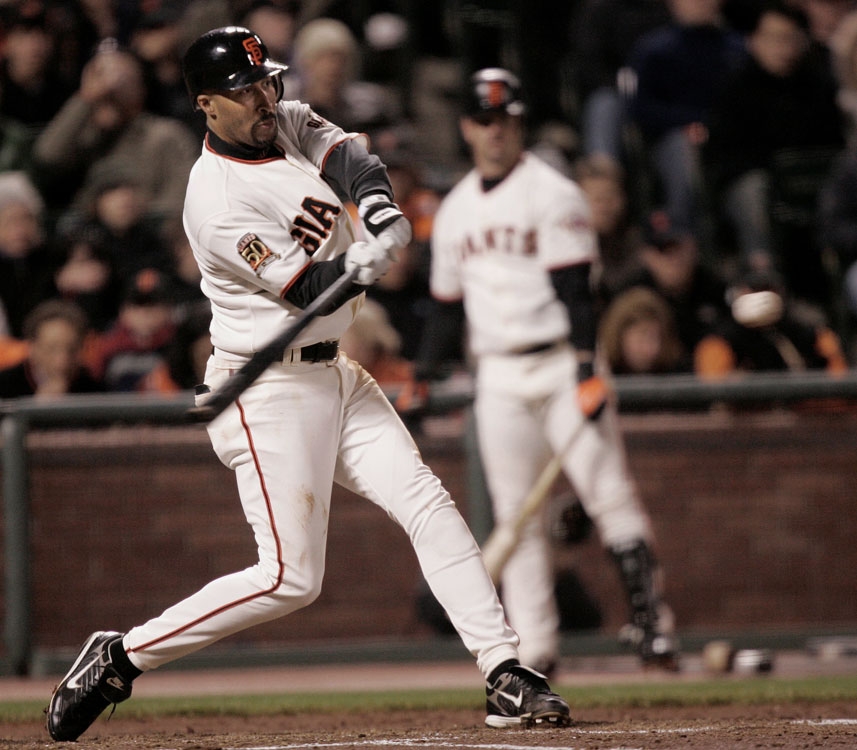
I was frustrated last season that there were players not playing hard enough. This group of guys is unbelievable. Even when we don’t win, we’re out there giving 150 percent every single day. There is so much heart on this team. Aaron Rowand is out there completely banged up and hurting and still diving for balls. Randy Winn is hurting and he’s going out there every day and putting his body on the line.
Our losses are very, very hard on us, in part because we know the fans take the losses hard, too. The fans are such a big part of what we do. If they’re not behind us, we lose something. I can’t even tell you want it is exactly. But we definitely feel it when the fans are behind us and when they’re not. I want them to know that, regardless of the outcome, we’re leaving everything on the field every day.
More later. Thanks for checking in.
Visiting Yadier and a catching familys story
We’re flying to St. Louis today (Wednesday) and will arrive in time, I hope, for me to have dinner with my little brother, Yadier, the catcher for the Cardinals.
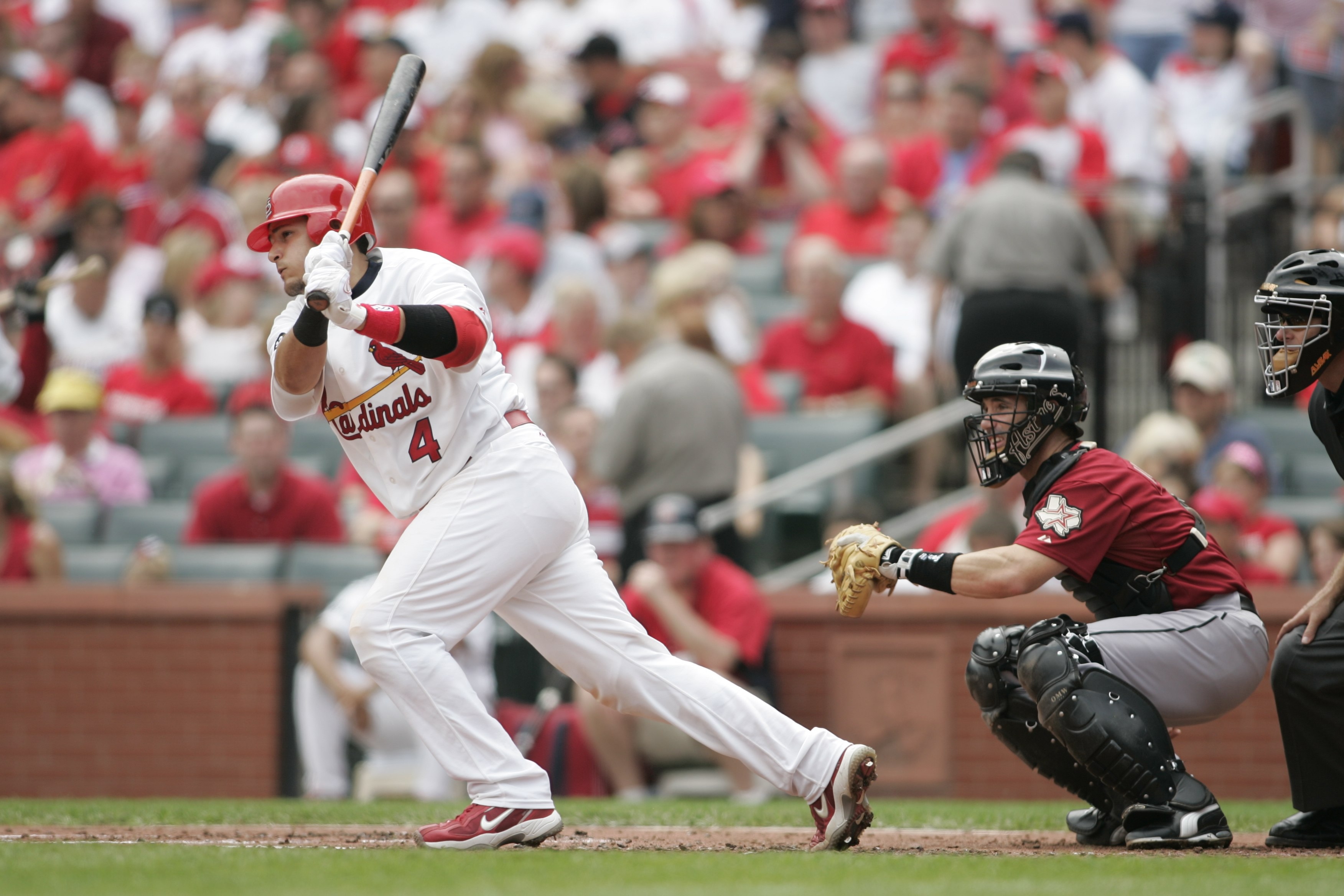 When the Cards were here last week, I took him to lunch before a game at Frutilandia, a Puerto Rican/Cuban restaurant in the Mission. It was great — a little taste of home. And my girlfriend and I had him over to our house for dinner one night, and we fell right into our long-running games of dominoes and poker and giving each other a hard time. (As many of you know, our middle brother, Jose, is also a catcher, for the New York Yankees. We have all somehow managed to win World Series rings. I’ve been told we’re the only trio of brothers in the history of Major League Baseball to do so.)
It’s funny that we all ended up as catchers. I had never caught a pitch in my life before an Angels scout visiting Puerto Rico put me behind the plate and told me to throw to second. The scout had come to check out Jose, not me. But my mother told him he should check me out, too. She didn’t tell him actually. She badgered him. She waved a newspaper clipping in the guy’s 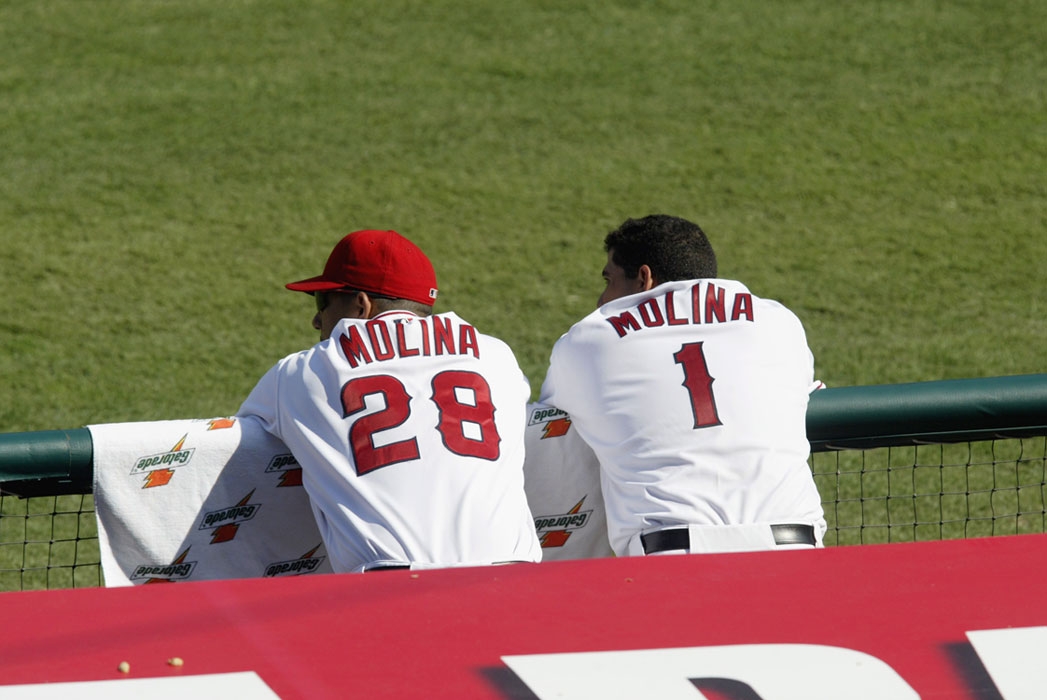
face showing that I had hit about .400 as an outfielder on the team that had won the amateur championship in Puerto Rico that year. Out of politeness or fear – I’m not sure which — he told my mother to have me on the field at 3 and he’d have a look.
When Jose gave me the news, I told him no. “You go have a great career,” I said. “It’s cool. I’m fine.” But Jose insisted.
I finally said OK but told him there was one problem.
I had no baseball shoes. He asked where they were. I took him outside and pointed up. There, dangling from the telephone wire, were my shoes.
A week before the scout arrived, I had tied the shoelaces together and tossed them up there. I had decided to quit baseball. I had played so hard and so well that season, I had done everything I could think to do, and still there was not a bit of interest from a single Major League team. Really, I would have signed for a box of Snickers. I just wanted to play pro ball. But nothing. So that was it, I thought. It was never going to happen. Time to move on.
Then my mother hammers the scout into giving me a tryout. Jose said I could wear his spikes, which I did. But they were two sizes too big. I looked like I was wearing clown shoes.
When the scout saw me warming up with Jose and my father, he liked what he saw in my arm. That’s when he told me to get behind the plate and throw to second. I rocketed the ball.
Three days later, the Angels signed me for $1,000 and sent me to rookie ball in Mesa, Arizona. All I had was a Lance Parris catcher’s mitt from Wal-Mart, which I thought was the greatest thing — until I saw the beautiful leather mitts the pros had. Still, I used the Lance Parrish mitt until the stitching ripped.
My brothers and I talk a lot about catching when we get together, and all of us agree that part of the beauty of the position — part of what we all love about it — is the psychology of managing pitchers.
Well, I’m at AT&T Park and we’re about to board the bus to SFO to catch our flight to St. Louis, so more on the psychology of catching in the next blog. Thanks for checking in.
Leading off…
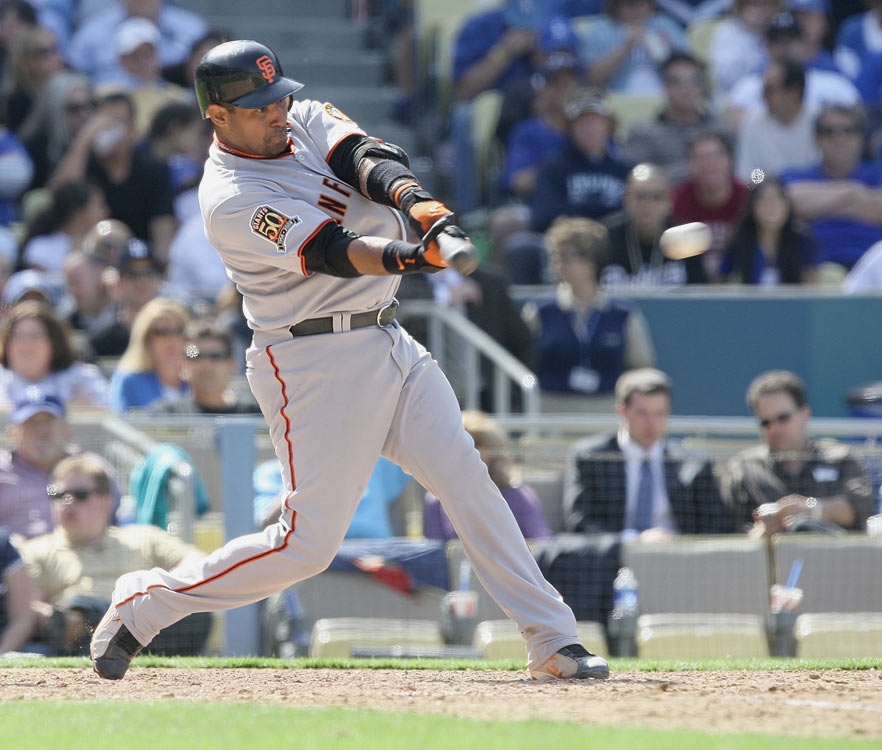
This is the first entry in a blog I’m hoping to keep updating throughout the season. Maybe it will give you a better feel for what it’s like in the clubhouse and on the field — and it will give me a chance to talk directly with fans and get to know them better.
I was thinking today about spring training and how pitchers have two ways to go: They can polish their best stuff, or they can work on the stuff that needs to get better. Obviously, you win more games in spring training when you put your best stuff out there. Our pitchers didn’t do that. We were always thinking about the season, not that particular spring-training game. We didn’t win a lot of games. Our pitchers looked pretty bad out there sometimes. When they got frustrated, I’d say, “Look, don’t get mad. You’re doing this to get ready for the season.”
Now we’re seeing it pay off.
Three wins in a row.
I can’t tell you what a difference that makes in the clubhouse and in the dugout. Guys are joking around more. Everybody’s more laid back and relaxed. That first week was rough, no doubt about it. We came out of spring training with people saying we were going to be last in the whole baseball world, not just our division. When they say things like that and then all of sudden you start winning, that makes us believe again. You think, “OK, we can do it.”
It’s not that you ever stop believing, even during the worst slumps. For me, it’s all about faith and trust. I trust my teammates, and I always remind myself, “This is a marathon, not a sprint.” I’m always talking to the younger guys about that, how we’re in this for the long haul and to stay positive, to not be so hard on themselves. But words are only going to take you so far. Nothing boosts your confidence like winning.
I can see it in the guys on the mound. They’re not pressing. They’re locating the fastball, keeping batters off balance. They understand they don’t have to overpower everybody. It’s been a great week so far.
Feel free to write in with questions or comments. It’d be great to hear what you’re thinking.
 Behind the Mask